
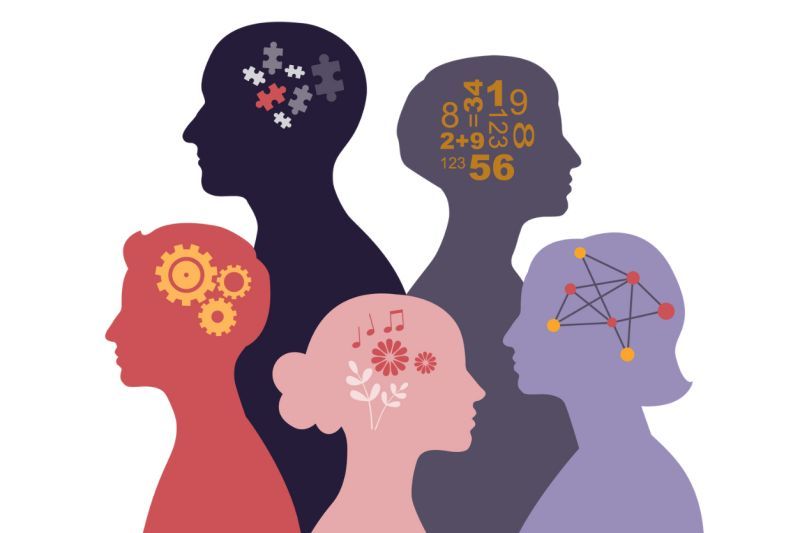
Our mindset is a set of beliefs that shape how you make sense of the world and yourself. It influences how you think, feel, and behave in any given situation. It means that what you believe about yourself impacts your success or failure.
Mindsets can influence how people behave in a wide range of situations in life. For example, as people encounter different situations, their mind triggers a specific mindset that then directly impacts their behaviour in that situation.
According to Stanford psychologist Carol Dweck, your beliefs play a pivotal role in what you want and whether you achieve it.1
Fixed vs. Growth Mindsets
Dweck describes two basic mindsets: fixed and growth. If you have a fixed mindset, you believe your abilities are fixed traits and therefore can’t be changed. You might also believe that your talent and intelligence alone lead to success, and effort is not required.
On the flip side, if you have a growth mindset, you believe your talents and abilities can be developed over time through effort and persistence. People with this mindset don’t necessarily believe that anyone can become Einstein or Mozart, but that everyone can get smarter or more talented if they work at it.
Here are some fixed vs. growth mindset examples.
| Fixed Mindset | Growth Mindset |
| Either I’m good at it or I’m not. | I can learn to do anything I want. |
| That’s just who I am. I can’t change it. | I’m a constantly evolving work in progress. |
| If you have to work hard, you don’t have the ability. | The more you challenge yourself, the smarter you become. |
| If I don’t try, then I won’t fail. | I only fail when I stop trying. |
| That job position is totally out of my league. | That job position looks challenging. Let me apply for it. |
How Mindset Forms
So how is your mindset created in the first place? Dweck’s research reveals two primary sources: praising and labelling, both of which occur in early childhood.
The Impact of Praise
In a landmark series of experiments, Dweck and her colleagues found that kids behaved very differently depending on the type of praise they received.2 They found that personal praise, or praising a child’s talents or labelling them as “smart,” promotes a fixed mindset. It sends a message to a child that they either have an ability or they don’t, and that there is nothing they can do to change that fact.
Process praise, on the other hand, emphasises the effort a person puts in to accomplish a task. It implies their success is due to the effort and the strategy they used, both of which they can control and improve over time.
Here’s an example of how they’re different. If your child gets a good grade on a maths test, personal praise might be, “See, you are good at maths. You got an A in your test.” Process praise, on the other hand, might sound like this: “I’m impressed by how hard you studied for your maths test. You read the material over several times, asked your teacher to help you figure out the tricky problems, and tested yourself on it. That really worked!”
Adults can take steps to ensure that their children develop growth mindsets by praising efforts not results. By focusing on the process rather than the outcome, adults can help kids understand that their efforts, hard work, and dedication can lead to change, learning, and growth both now and in the future.
The Impact of Labels
Labelling, which involves assigning people characteristics based on stereotypes or associations with different groups, can also lead to the development of fixed or growth mindsets. A person who holds a stereotype that girls are bad at maths or that boys are bad at reading may form a fixed mindset about their own abilities in those specific domains.
For example, researchers have found that just having students check boxes about sex and race was enough to invoke internalized stereotypes that affected test performance.
The Impact of Mindset
Your mindset plays a critical role in how you cope with life’s challenges. When a child has a growth mindset, they tend to have a hunger for learning and a desire to work hard and discover new things. This often translates into academic achievement.
As adults, these same people are more likely to persevere in the face of setbacks. Instead of throwing in the towel, adults with a growth mindset view it as an opportunity to learn and grow. On the other hand, those with fixed mindsets are more likely to give up in the face of challenging circumstances.
In her book “Mindset: The New Psychology of Success,” Dweck writes that those with fixed mindsets are constantly seeking the validation to prove their worth not just to others, but also to themselves.4
What Is My Mindset?
Do you have a fixed or growth mindset? To find out, start by reading the following statements and decide which ones you agree with most:
- You’re born with a certain amount of intelligence and it isn’t something that can be changed.
- No matter who you are, there isn’t much you can do to improve your basic abilities and personality.
- People are capable of changing who they are.
- You can learn new things and improve your intelligence.
- People either have particular talents, or they don’t. You can’t just acquire talent for things like music, writing, art, or athletics.
- Studying, working hard, and practising new skills are all ways to develop new talents and abilities.
If you tend to agree most with statements 1, 2, and 5, then you probably have a more fixed mindset. If you agree most with statements 3, and 4, 6, however, then you probably tend to have a growth mindset.
How to Unfix a Fixed Mindset
While people with a fixed mindset might not agree, Dweck suggests that people are capable of changing their mindsets. Here’s how.
- Focus on the journey. An important factor when building a growth mindset is seeing the value in your journey. When you’re fixated on the end result, you miss out on all the things you could be learning along the way.
- Incorporate “yet.” If you’re struggling with a task, remind yourself that you just haven’t mastered it “yet.” Integrating this word into your vocabulary signals that despite any struggles, you can overcome anything.
- Pay attention to your words and thoughts. Replace negative thoughts with more positive ones to build a growth mindset.
- Take on challenges. Making mistakes is one of the best ways to learn.5 So, instead of shying away from challenges, embrace them.
A mindset conclusion emphasizes that adopting a growth mindset—believing abilities grow through dedication—is key for resilience, learning, and success, contrasting with a fixed mindset where talents are static; this involves reframing challenges as opportunities, embracing effort as improvement, learning from failures, and realizing mindset isn’t just beliefs but neurological patterns influencing behavior and well-being, ultimately empowering continuous personal and professional development.
–Carol Marina Dsouza
About us
“Unlock your dream career with Draw My Career! Our AI-powered platform, personalized report, combined with expert counseling and lifelong support, helps you discover your passion, stay focused on your goals, and achieve success. We proudly claim to have positively impacted over 3,000 students in and around Mangalore, receiving overwhelmingly positive feedback. For expert career guidance,Take the first step towards a brighter future and let us guide you to write your own success story.”
Visit: www.drawmycareer.com