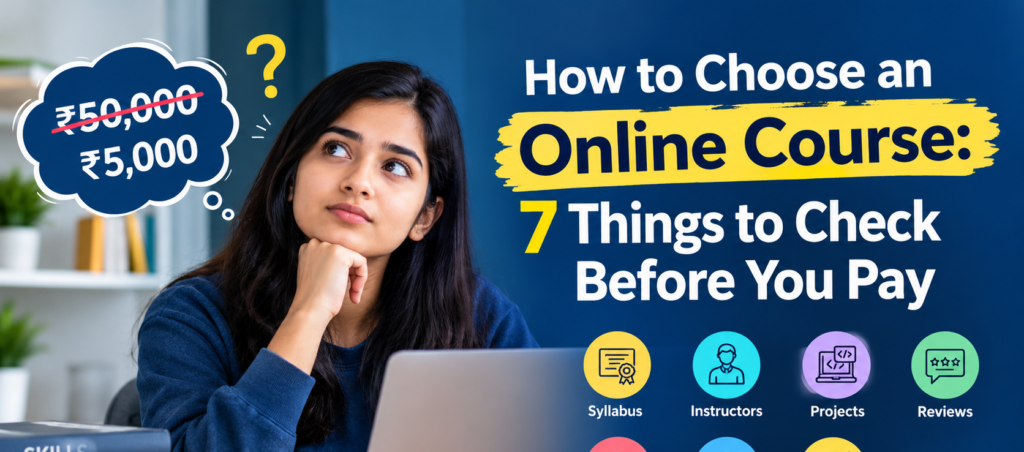
A ₹50,000 course isn’t automatically better than a ₹5,000 course.
Today, students have access to thousands of online courses promising better skills, certificates, high-paying jobs, and even guaranteed career growth. With attractive discounts, limited-seat offers, and impressive advertisements, it can be easy to make a quick decision.
But before paying for any online course, it is important to look beyond the price and certificate.
1. Check the Syllabus
The first question should be: Does this course actually teach what I want to learn?
Look at the syllabus carefully.
Check whether it includes:
- Current and relevant topics
- Practical applications
- Industry-relevant tools
- Projects or assignments
- Topics that match your career goal
A long syllabus does not necessarily mean a better course. What matters is whether the content is useful and up to date.
2. Know Who Is Teaching You
The instructor can make a huge difference to your learning experience.
Before enrolling, check:
- Their educational background
- Industry experience
- Professional achievements
- Previous teaching experience
- LinkedIn or professional profile
A popular name or social media following does not automatically mean someone is the right teacher for your learning needs.
3. Will You Actually Build Something?
Watching 50 hours of videos does not necessarily mean you have developed a skill.
Ask whether the course gives you opportunities to apply what you learn.
For example:
- Coding courses should involve coding projects.
- Design courses should help you create a portfolio.
- Digital marketing courses should include practical campaigns or case studies.
- Data courses should involve working with real datasets.
A good course should help you move from “I learned it” to “I can do it.”
4. Don’t Trust Reviews Blindly
Reviews can be useful, but don’t look only at the star rating.
Read detailed reviews and ask:
- What exactly did the student learn?
- Did they complete the course?
- Did they build projects?
- Was the instructor supportive?
- Did the course match the advertisement?
Be careful with reviews that are concise, repetitive, or make unrealistic claims.
5. Understand “Placement Assistance”
“Placement assistance” does not always mean a guaranteed job.
Before enrolling, ask what the term actually includes.
It could mean:
- Resume support
- Interview preparation
- Job alerts
- Mock interviews
- Connecting students with recruiters
- Actual placement opportunities
Always ask for clear details instead of assuming that placement assistance means a job guarantee.
6. Compare Free and Cheaper Alternatives
Before spending ₹20,000, ₹50,000 or more, spend some time researching alternatives.
You may find:
- Free tutorials
- YouTube lessons
- Affordable courses
- Government learning platforms
- Books and documentation
- Practice websites
- Free projects and resources
A paid course can still be valuable if it provides structure, mentorship, feedback, projects and support that free resources don’t offer.
7. Look at the Outcome
Perhaps the most important question is:
“What will I be able to show after completing this course?”
A certificate is useful, but your actual skills matter more.
By the end of the course, you should ideally have something that demonstrates your ability, such as:
- Projects
- Portfolio work
- Case studies
- Presentations
- GitHub work
- Designs
- Research
- Practical assignments
Your work becomes proof of your skill.
Certificate vs Skill: What Matters More?
A certificate can support your profile, but a certificate alone cannot demonstrate what you can actually do.
Think of it this way:
Certificate = Evidence that you completed learning
Skill = What you can actually do
Project = Proof that you can apply the skill
The strongest combination is therefore:
Learn → Practise → Build → Showcase
Don’t Let Discounts Make the Decision
A course originally priced at ₹50,000 and offered today for ₹4,999 may look like an incredible deal.
But don’t ask:
“How much am I saving?”
Ask:
“Is this course worth ₹4,999 for my career goal?”
The original price may not tell you anything about the actual value of the course.
Ask These Questions Before You Pay
Before enrolling in any online course, take a few minutes to check:
- ✔ Is the syllabus relevant to my goal?
- ✔ Who is teaching the course?
- ✔ Is the content updated?
- ✔ Will I get practical experience?
- ✔ Will I build projects?
- ✔ Are the reviews genuine?
- ✔ What does placement assistance actually include?
- ✔ Are there better or cheaper alternatives?
- ✔ Will I have something useful to showcase after completing it?
If you cannot find clear answers, pause before making the payment.
Final Thought
The most expensive course isn’t necessarily the best course.
And the cheapest course isn’t necessarily the worst.
The right course is the one that gives you relevant knowledge, practical skills, guidance and opportunities to demonstrate what you have learned.
Before paying for a course, don’t get impressed by the certificate, discount, “limited seats” message or big career promises.
Verify first. Learn smart. Build real skills.
At DrawMyCareer, we believe career decisions should be based on understanding your interests, abilities, skills and career opportunities—not simply following trends or advertisements.
Choose learning that moves you closer to your career goal.