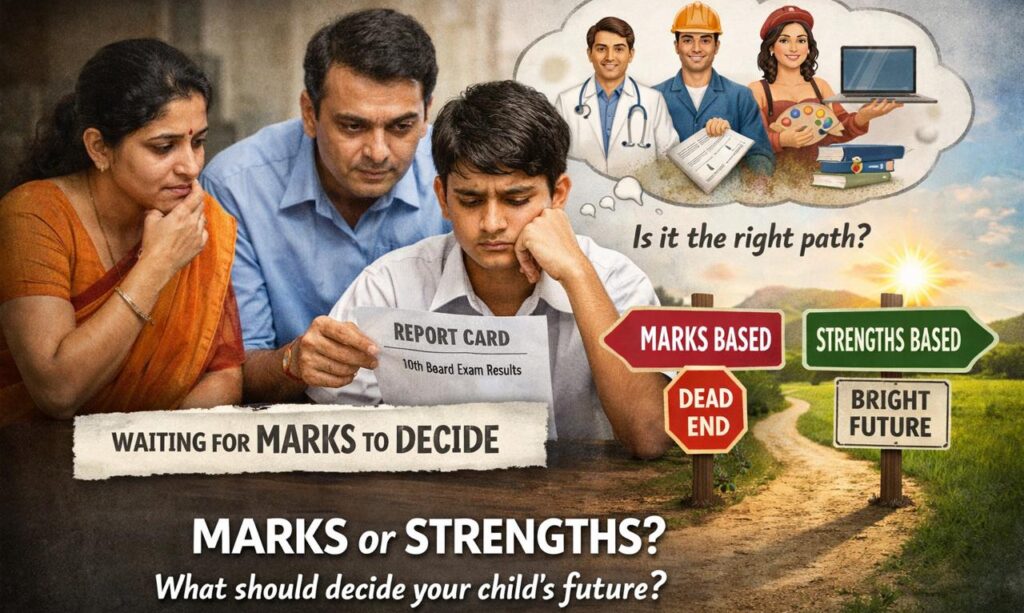
As a career counselor working closely with students and parents, I have often observed one powerful truth — many career decisions are not made by children, but by their parents’ conditioned minds.
Parents want the best for their children. Their intentions are pure. But sometimes, their beliefs are shaped by fear, past experiences, social pressure, and outdated information. When these unconscious prejudices influence career decisions, the long-term impact on a child can be serious.
What is a “Conditioned Mind”?
A conditioned mind is formed by:
- Society’s definition of “success”
- Family traditions
- Financial fears
- Comparison with relatives’ children
- Limited exposure to new-age careers
- Personal unfulfilled dreams
For example:
“Only doctors and engineers are successful.”
“Arts has no scope.”
“Government job is safest.”
“Creative fields are unstable.”
These statements may have been true 20–30 years ago, but the world has changed dramatically.
The World of Careers Has Changed
Parents must understand that the career landscape today is different from what it was a few decades ago.
Earlier, the choices were limited to a few traditional professions such as:
- Doctor
- Engineer
- Government Officer
- Teacher
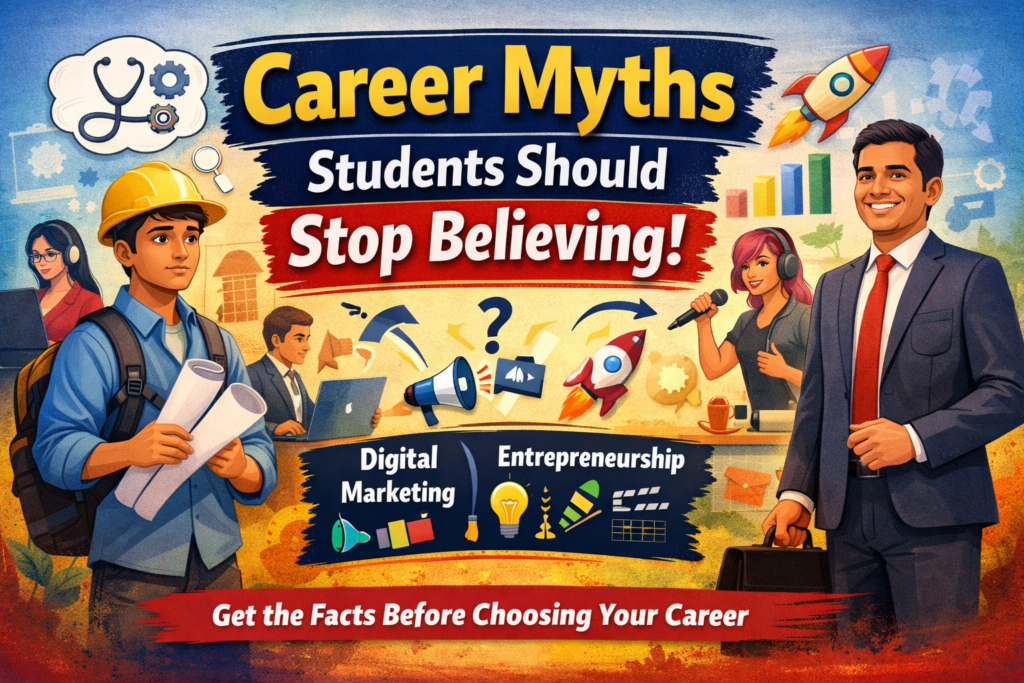
But today, thousands of career paths exist across industries like:
- Artificial Intelligence
- Data Science
- Digital Marketing
- UX/UI Design
- Psychology
- Game Design
- Animation & VFX
- Sports Management
- Entrepreneurship
- Environmental Science
Many of these careers did not even exist when parents were students.
This is why relying only on past experiences can lead to outdated career advice.
Parents today need updated information, not just traditional beliefs.
Common Parental Prejudices in Career Decisions
- Prestige-Based Decisions -Choosing a career for status rather than suitability.
- Fear-Based Decisions -Selecting “safe” options because of job security fears.
- Comparison Culture -“Sharma ji’s son became an engineer, so you must too.”
- Financial Pressure -Belief that only certain careers guarantee income.
- Gender Stereotyping -“Girls should choose stable desk jobs.”
“Boys should not take arts.” - Waiting for Marks to Decide the Career
This is one of the most common patterns seen in families:
“Let the 10th/12th marks come first… then we will decide.”Marks become the deciding factor for stream selection and career choice. But here is the critical question:
Should marks decide the future — or should strengths decide the future?
Why is depending only on marks risky
1. Marks Reflect Performance, Not Potential
Marks show how well a child performed in a particular exam — not their natural intelligence, personality, creativity, or long-term aptitude. A child scoring high in science does not automatically mean they are suited for engineering or medicine.
2. Marks Are Influenced by Many External Factors
- Exam anxiety
- Health issues
- Evaluation patterns
- Coaching support
- Rote learning ability
These factors do not define lifelong capability.
3. Last-Minute Decisions Create Pressure
When parents wait for results and suddenly decide the stream, the child has very little time for clarity, preparation, or competitive exam planning.
This often leads to confusion and rushed decisions.
Every Child Has a Unique Combination of Strengths
Children are not identical. Each child has a unique mix of:
- Aptitude
- Personality
- Interests
- Learning style
- Emotional intelligence
- Creativity
Two students with the same marks can succeed in completely different careers.
For example:
One student may excel in analytical thinking and enjoy engineering. Another may have strong communication and empathy, making them suitable for psychology, law, or management. Career decisions should therefore be based on strength alignment, not just marks.
Why Early Career Decisions Are Important
Early decision does not mean forcing a fixed career at age 13.
It means early awareness, exploration, and direction.
1. Right Subject Selection
Choosing the correct stream after 10th can open or close future options. An informed early choice prevents regret later.
2. Strategic Preparation
If a child knows their direction early:
- They can prepare for entrance exams properly
- They can build portfolios (design, psychology, law, etc.)
- They can take relevant internships and skill courses
Preparation becomes focused rather than random.
3. Confidence & Motivation
When children know why they are studying something, their commitment increases. Clarity builds confidence.
4. Financial Planning
Early planning helps parents understand:
- Education costs
- Scholarships
- Long-term investment required
5. Reduced Stress After Results
Instead of panic after board results, the family already has a clear roadmap.
The Role of Scientific Career Assessment
One of the biggest mistakes families make is guessing the right career.
Modern career guidance uses psychometric assessments that scientifically evaluate:
- Aptitude
- Personality
- Interest areas
- Learning preferences
- Career compatibility
These assessments provide objective insights and help parents move away from emotional or fear-based decisions.
They create a data-driven approach to career planning.
Exposure Creates Career Awareness
Many children choose careers simply because they have never been exposed to alternatives.
Parents can help by encouraging:
- Career workshops
- Internships
- Interaction with professionals
- Industry visits
- Skill development programs
- Online learning platforms
Exposure helps children visualize real career paths instead of assumptions.
The Importance of Career Conversations at Home
Career discussions should not happen only after board results.
Healthy career conversations should begin early.
Parents can ask questions like:
- What activities do you enjoy the most?
- What kind of problems do you like solving?
- Do you enjoy working with people, ideas, or systems?
- What type of environment excites you?
When parents listen without judgment, children feel safe to express their aspirations.
This strengthens trust and clarity.
How Parental Conditioning Affects the Child
When careers are decided only after marks:
- Children feel they are valued only for scores
- Self-worth becomes linked to numbers
- Fear of failure increases
- True interests remain unexplored
- Long-term dissatisfaction becomes common
Many adults today are working in careers chosen based on marks — not passion or aptitude — and are now seeking career changes in their late 20s and 30s.
Success Is No Longer Linear
In the past, career paths were predictable:
Study → Degree → Job → Retirement
Today, careers are dynamic and evolving.
People may:
- Change industries
- Build multiple skills
- Start businesses
- Work globally
- Create hybrid careers
The most important skill today is adaptability and lifelong learning.
What Parents Must Shift
Instead of saying:
“Let’s see your marks first.”
Start saying:
“Let’s understand your strengths first.”
Marks should support a decision — not control it.
Parents must remember that their role is not to decide the future, but to guide the discovery process.
Children need wisdom, support, and encouragement — but they also need ownership of their career decisions.
To Reflect
A child’s future should not be a reaction to an exam result.
It should be a result of awareness, planning, and understanding.
Marks are temporary,Careers are long-term.
When parents move from fear-based decisions to informed decisions, they don’t just choose a stream — they protect their child’s future happiness.
Children don’t need parents who choose a career for them.
They need parents who help them discover the career that is meant for them.
–Philomena Dsouza
About us
“Unlock your dream career with Draw My Career! Our AI-powered platform, personalized report, combined with expert counseling and lifelong support, helps you discover your passion, stay focused on your goals, and achieve success. We proudly claim to have positively impacted over 3,000 students in and around Mangalore, receiving overwhelmingly positive feedback. For expert career guidance,Take the first step towards a brighter future and let us guide you to write your own success story.”
Visit: www.drawmycareer.com