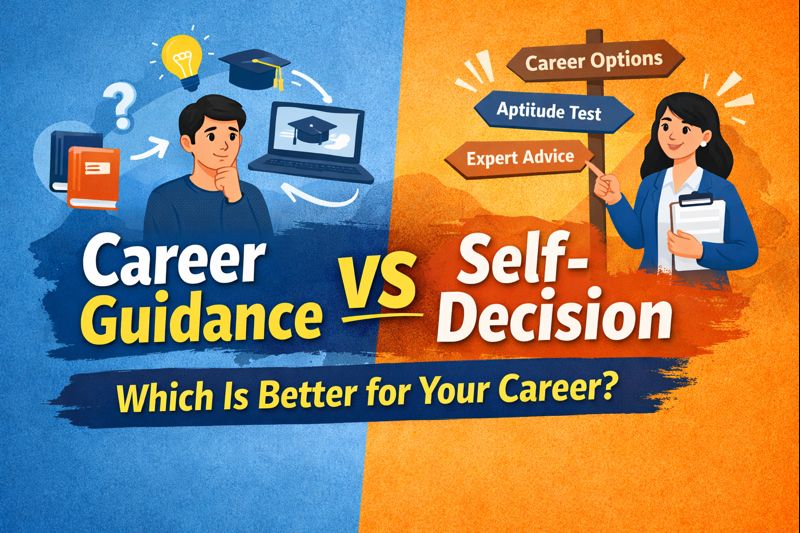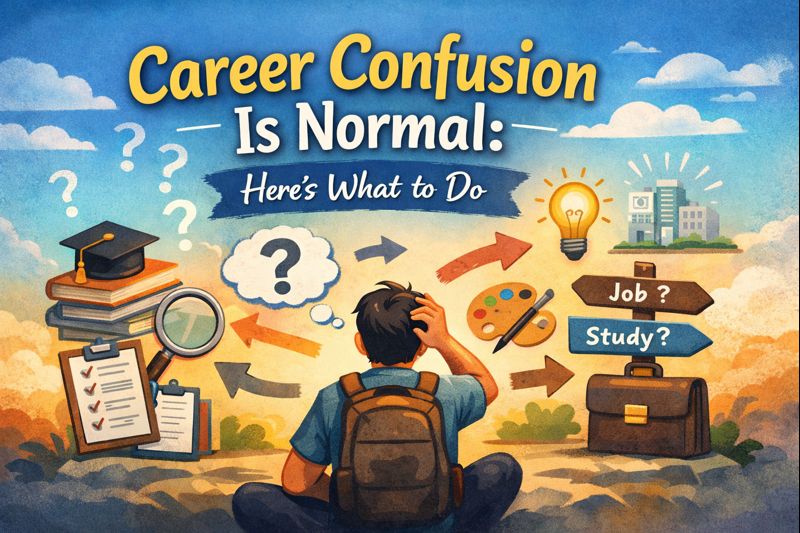

Feeling confused about your career is normal—not a failure. Many students feel lost after 10th, 12th, or even graduation. The problem isn’t confusion; it’s ignoring it.
- Pause and accept the confusion
Career confusion doesn’t mean you’re incapable. It means you’re at a decision point. Stop comparing your journey with others—everyone moves at a different pace.
- Understand yourself first
Before choosing a career, ask:
- What subjects interest me?
- What are my strengths?
- Do I enjoy working with people, data, creativity, or systems?
- What kind of lifestyle do I want?
Clarity starts with self-awareness, not Google searches.
- Explore options beyond the “popular” ones
Engineering, MBBS, CA, and government jobs are not the only successful careers. Explore:
- Allied health sciences
- Psychology, data & analytics
- Design, product management, finance
- Skill-based and emerging careers
4. Talk to the right people
Don’t rely only on friends or relatives. Speak to:
- Career counselors
- Professionals working in the field
- Seniors who are already studying those courses
- Real insights reduce fear.
5. Use career assessments
A scientific career assessment can help identify:
- Personality
- Career Interest
- Career motivation
- Aptitude
- Learning Style
This gives you direction and reduces random decision-making.
6. Take small steps, not lifelong decisions
You don’t need to plan your entire life today. Choose a direction, gain skills, do internships, and course-correct if needed.
👉 Remember: A career is a journey, not a one-time decision.
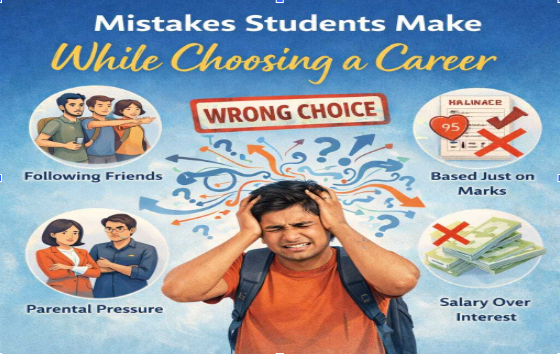
Mistakes Students Make While Choosing a Career
Many students don’t fail because of lack of talent—but because of wrong career choices. Here are the most common mistakes to avoid:
- Following the crowd
- Choosing a career just because friends are choosing it often leads to dissatisfaction and burnout. What suits others may not suit you.
- Choosing based only on marks
- Marks don’t define your potential. A student with average marks but the right skills and interest can outperform toppers in the wrong field.
- Parental pressure without discussion
- Parents want the best, but decisions made without understanding the student’s interest often create long-term stress and regret.
- Ignoring personal interests and strengths
- A career chosen without interest becomes a burden. Skills can be developed—but interest is hard to force.
- Focusing only on salary
- Money matters, but choosing a career only for salary often leads to unhappiness. Long-term success comes when skill, interest, and opportunity align.
- Not researching the course or career
- Many students don’t check:
- Course syllabus
- Career scope
- Required skills
- Job roles
- This leads to disappointment later.
- Not taking professional guidance
- Career guidance isn’t a luxury—it’s a necessity today. One right discussion can save years of confusion.
🌟 A NOTE TO STUDENTS
A wrong career choice costs time, money, and confidence.A right career choice builds clarity, growth, and satisfaction.Choosing a career is not about being perfect—it’s about being informed and intentional. The right guidance today can save years of regret. tomorrow.
–Philomena Dsouza
About us
“Unlock your dream career with Draw My Career! Our AI-powered platform, personalized report, combined with expert counseling and lifelong support, helps you discover your passion, stay focused on your goals, and achieve success. We proudly claim to have positively impacted over 3,000 students in and around Mangalore, receiving overwhelmingly positive feedback. For expert career guidance,Take the first step towards a brighter future and let us guide you to write your own success story.”
Visit: www.drawmycareer.com