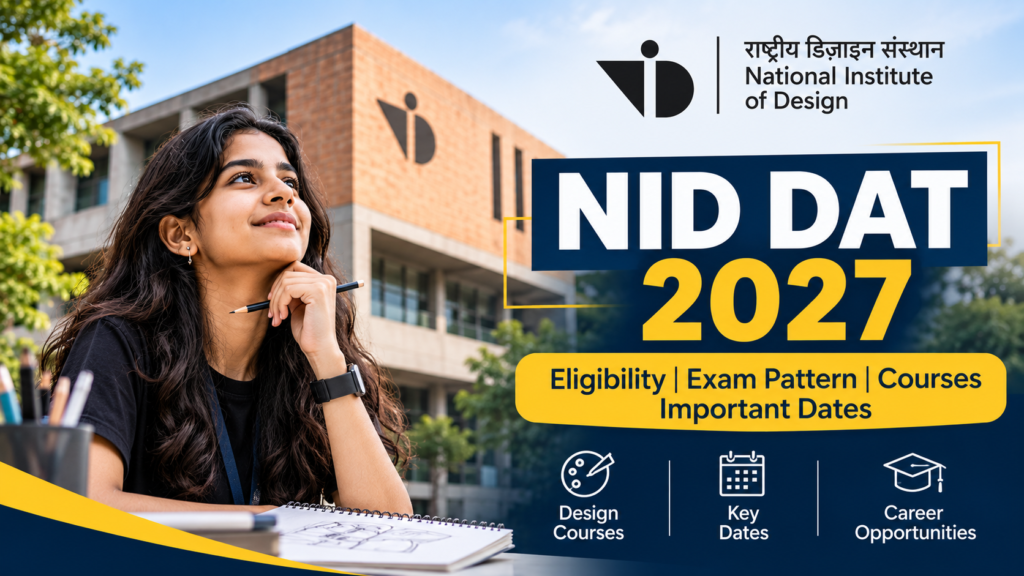
Are you a student interested in creativity, drawing, product development, animation, fashion or visual communication? The National Institute of Design Design Aptitude Test (NID DAT) 2027 is an entrance examination for students aspiring to pursue professional design education at the National Institute of Design (NID).
NID offers programmes that help students develop creative thinking, design skills, visual communication and practical problem-solving abilities. Students from Science, Commerce and Arts backgrounds can explore undergraduate design programmes after Class 12.
The NID DAT 2027 admission process is now open for the 2027–28 academic year. Here is everything students and parents need to know about eligibility, courses, examination stages, important dates and career opportunities.
What is NID DAT?
NID DAT stands for National Institute of Design – Design Aptitude Test. It is the entrance examination conducted by the National Institute of Design for admission to its design programmes.
The examination evaluates a candidate’s creative abilities, observation skills, visualisation, analytical thinking and design aptitude.
- Exam name: NID Design Aptitude Test (DAT)
- Conducting authority: National Institute of Design
- Exam level: National
- Admission year: 2027–28
- Programmes: B.Des. and Integrated M.Des. after Class 12, and M.Des. for eligible graduates
- Selection stages: DAT Prelims and DAT Mains
Courses offered through NID DAT
Students can explore different design specialisations depending on the campus and programme.
Some major design disciplines include:
- Industrial Design
- Product Design
- Communication Design
- Graphic Design
- Animation Film Design
- Film and Video Communication
- Textile Design
- Apparel and Lifestyle Accessory Design
- Furniture and Interior Design
- Exhibition and Spatial Design
- Ceramic and Glass Design
Note: Not every discipline is available at every NID campus. Students should check the latest admission handbook for campus-wise course availability.
Eligibility criteria for NID DAT 2027
Students applying for undergraduate admission must meet the following eligibility requirements:
Educational qualification
- Candidates who have passed Class 12 or are appearing for their Class 12 examination in the 2026–27 academic year can apply.
- Students from Science, Commerce, Arts and Humanities streams are eligible.
- Candidates must have completed their education through a recognised board or an equivalent qualification.
Age limit
For Indian nationals:
- General and General-EWS: Born on or after 1 July 2006.
- OBC-NCL, SC and ST: Born on or after 1 July 2003.
- PwD reserved category: Born on or after 1 July 2001.
Important: Students must check the detailed eligibility conditions in the official admission handbook before applying.
NID DAT 2027 examination pattern
The NID admission process consists of two stages.
Stage 1: DAT Prelims
- Conducted as a paper-and-pencil/pen examination.
- Questions may include text and visual elements.
- Tests creative thinking, observation, visualisation and design aptitude.
- The question paper is in English.
- The examination duration will be mentioned on the admit card.
Stage 2: DAT Mains
Candidates shortlisted through DAT Prelims can appear for DAT Mains.
It consists of two parts:
- Studio Sensitivity Test
- In-Person Sensitivity Test
The DAT Mains evaluates candidates’ design abilities, practical understanding and creative approach. The final admission merit list is based on DAT Mains performance.
Note: DAT Prelims scores are used for shortlisting and are not carried forward as
Important dates for NID DAT 2027
Applications open
| Admission event | Important date |
| Application start date | 10 September 2026 |
| Last date to apply | 30 November 2026 |
| Application correction window | 1–3 December 2026 |
| DAT Prelims admit card | 10 December 2026 |
| DAT Prelims examination | 20 December 2026 |
| DAT Prelims result | 16 March 2027 |
| DAT Mains examination | To be announced |
Dates are based on the official 2027–28 admission handbook. Candidates should check the official portal for amendments.
NID campuses participating in the admission process
The participating National Institute of Design campuses include:
- NID Ahmedabad
- NID Andhra Pradesh
- NID Haryana
- NID Madhya Pradesh
- NID Assam
- NID Bengaluru
- NID Gandhinagar
Programme update for 2027–28: NID Ahmedabad, Gandhinagar and Bengaluru offer a 5.5-year Integrated Master of Design pathway after Class 12. Other participating campuses have programme structures that include 5.5-year Integrated M.Des. and/or four-year B.Des., depending on the campus. Check the individual institute’s programme details before applying.
How to apply for NID DAT 2027?
Candidates can complete their application online through the official NID admission portal.
Follow these steps:
- Visit https://admissions.nid.edu/
- Register using your email ID and mobile number.
- Select the appropriate admission programme.
- Fill in personal and educational details.
- Upload the required documents and photograph.
- Pay the prescribed application fee.
- Submit the application form and save the confirmation.
Application deadline: 30 November 2026.
Skills required to prepare for NID DAT
NID DAT focuses on identifying students with creative potential and design aptitude. Students can start preparing by developing the following skills:
- Creative thinking: Develop original ideas and explore different solutions.
- Drawing and sketching: Practise communicating ideas through illustrations.
- Observation: Understand shapes, objects, patterns and everyday surroundings.
- Visualisation: Improve the ability to imagine and represent objects in different forms.
- Problem-solving: Learn to approach everyday challenges creatively.
- Design awareness: Understand colours, composition, materials and basic design principles.
- Logical thinking: Develop analytical and reasoning abilities.
Students should also practise previous-year questions and sample papers to become familiar with the examination format.
Career opportunities after studying design
A design qualification can open opportunities across several creative and technology-driven industries.
Some career options include:
| Career | Work area |
| Product Designer | Designing useful products and solutions |
| UI/UX Designer | Creating digital user experiences |
| Graphic Designer | Visual communication and branding |
| Animation Designer | Animation and visual storytelling |
| Textile Designer | Developing fabrics and patterns |
| Fashion Designer | Clothing and lifestyle products |
| Industrial Designer | Designing consumer and industrial products |
| Interior Designer | Planning functional interior spaces |
| Interaction Designer | Designing interactive digital experiences |
| Design Researcher | Studying user needs and design problems |
Is NID DAT the right choice for you?
NID DAT may be worth exploring if you:
- Enjoy drawing, designing and creating new things.
- Have an interest in art, technology and innovation.
- Like solving problems through creative ideas.
- Are interested in products, graphics, animation or fashion.
- Want to explore careers in the design industry.
Students should understand their interests, strengths and abilities before choosing a design specialisation.
How DrawMyCareer helps students choose the right career
Choosing a career after Class 10 or Class 12 is an important decision. Students often have multiple interests but may not know which educational pathway suits them.
DrawMyCareer helps students make informed career decisions through scientific career assessments, personalised career counselling and career awareness programmes.
Through our career guidance services, students can explore their interests, personality, abilities and potential career clusters before deciding on courses and colleges.
Visit DrawMyCareer to explore career guidance services.
Conclusion
NID DAT provides an opportunity for students to explore professional education in design and develop their creative potential. Students interested in design should understand the available programmes, eligibility requirements and admission process before applying.
Early preparation, regular creative practice and proper career guidance can help students make informed decisions about their future.
Don’t choose a career just because it is popular. Discover your interests, understand your abilities and explore the right career pathway with DrawMyCareer!