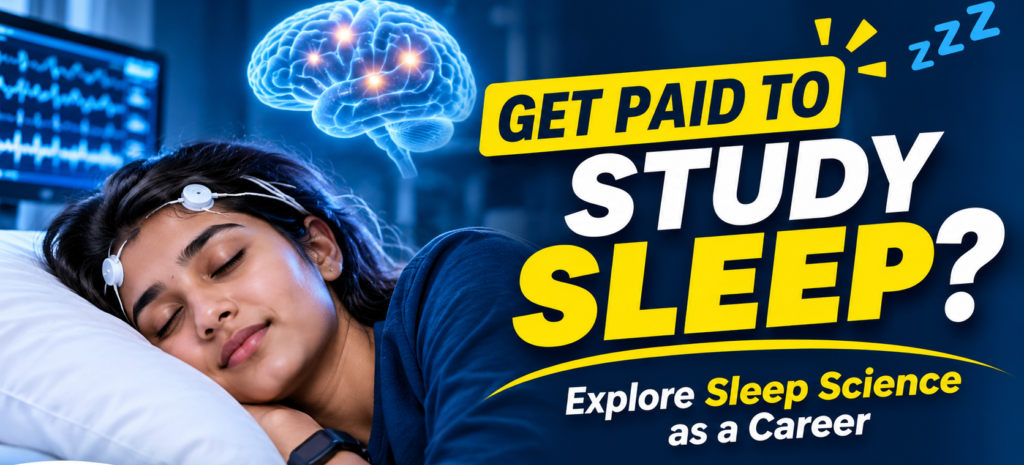
Can you imagine building a career around something everyone does every day – sleeping?
What if we told you that sleep is not just a daily routine but also an area of science that offers interesting career opportunities?
From studying brain activity during sleep to understanding sleep disorders and monitoring sleep patterns, professionals in this field play an important role in healthcare and medical research.
Welcome to the world of Sleep Science and Sleep Technology – an interesting career pathway for students interested in healthcare, biology, neuroscience and technology.
Let’s explore how you can turn your interest in sleep into a professional career!
What Is Sleep Science?
Sleep Science is the study of sleep patterns, sleep cycles, brain activity and the biological processes that take place while a person sleeps.
It combines different fields, including:
- Neuroscience
- Psychology
- Physiology
- Respiratory Science
- Medical Technology
- Healthcare Research
Sleep researchers and healthcare professionals study conditions such as insomnia, sleep apnoea, narcolepsy and other sleep-related disorders.
Can You Really Get Paid to Sleep?
Yes, but there is an interesting difference!
Researchers sometimes recruit volunteers for sleep studies to understand how the human body and brain behave during sleep.
Participants may receive compensation for taking part in approved research studies, depending on the study and its conditions.
However, this does not mean that sleeping itself is a regular salaried profession.
The actual career opportunity lies in becoming a trained professional who studies, monitors and analyses sleep.
What Does a Sleep Technologist Do?
A Sleep Technologist works in a sleep laboratory and assists healthcare professionals in studying patients’ sleep patterns.
Their responsibilities may include:
- Preparing patients for sleep studies.
- Monitoring sleep patterns and brain activity.
- Operating specialised sleep-monitoring equipment.
- Recording breathing patterns, oxygen levels and body movements.
- Assisting in polysomnography (PSG) tests.
- Supporting doctors in analysing sleep-study results.
One important technology used in this field is Polysomnography, a comprehensive sleep test that records different body activities during sleep.
Which Course Should You Study?
If you are interested in entering this field, explore the following educational pathways.
A. B.Sc. Sleep Technology
This is a specialised allied health science pathway focusing on sleep studies and sleep laboratory technology.
Students learn about:
- Sleep physiology
- Sleep disorders
- Neurophysiology
- Polysomnography
- Sleep laboratory procedures
- Patient monitoring
B. B.Sc. Respiratory Care Technology
This course focuses on respiratory health, breathing-related conditions and respiratory care.
It can also provide exposure to sleep medicine and sleep laboratory procedures.
C. B.Sc. Neuroscience / Neurophysiology-related courses
These courses help students understand brain functions, nervous system activity and the biological mechanisms associated with sleep.
D. Psychology
Students interested in the relationship between sleep, behaviour and mental health can explore psychology.
Further education and specialisation can lead to research and clinical opportunities related to sleep.
E. MBBS – Medical Pathway
Students who want to become doctors specialising in sleep-related conditions can pursue MBBS, followed by relevant postgraduate medical training and specialisation in fields such as pulmonology, neurology or psychiatry, with further training in sleep medicine.
Colleges and Institutions in India to Explore
Here are some institutions with documented courses, departments or training opportunities related to sleep technology and sleep medicine.
1. AIIMS Rishikesh, Uttarakhand
AIIMS Rishikesh has documented a B.Sc. Sleep Technology programme and offers sleep laboratory facilities.
Official website: https://aiimsrishikesh.edu.in/
2. St. John’s Medical College, Bengaluru
St. John’s offers allied health science education and has a well-equipped sleep laboratory. Its pulmonary medicine department also documents training and educational programmes related to sleep medicine.
Official website: https://www.stjohns.in/
3. AIIMS New Delhi
Its Department of Pulmonary, Critical Care and Sleep Medicine provides clinical, academic and research exposure in sleep medicine.
Official website: https://www.aiims.edu/
4. VMMC and Safdarjung Hospital, New Delhi
The Department of Pulmonary Medicine has a dedicated sleep laboratory and postgraduate training in pulmonary and sleep medicine.
Official website: https://vmmc-sjh.mohfw.gov.in/
Important: Not every institution listed offers a direct undergraduate Sleep Technology degree. Some provide medical training, allied health education or postgraduate specialisation. Check the latest admission prospectus, course availability and eligibility before applying.
What Is the Eligibility?
Eligibility depends on the course and institution.
For undergraduate allied health science programmes, students generally need to complete Class 12 with relevant science subjects.
Commonly required subjects may include:
- Physics
- Chemistry
- Biology
Some programmes may have additional subject, minimum-mark or entrance examination requirements.
For medical specialisation, students must follow the prescribed MBBS and postgraduate medical admission pathway.
Always check the institution’s current eligibility criteria before applying.
Career Opportunities in Sleep Science
After obtaining the required qualifications and training, students can explore roles such as:
- Sleep Technologist
- Polysomnography Technologist
- Sleep Laboratory Technician
- Respiratory Care Technologist
- Clinical Research Assistant
- Neurophysiology Technologist
- Sleep Research Professional
Potential workplaces include:
- Hospitals
- Sleep laboratories
- Respiratory care centres
- Medical research institutions
- Healthcare organisations
- Academic and research centres
The exact job opportunities depend on the qualification, practical training and employer requirements.
What Skills Are Required?
Students interested in this field should develop:
- Interest in biology and human physiology
- Understanding of medical technology
- Observation and analytical skills
- Attention to detail
- Communication skills
- Patience and responsibility
- Interest in healthcare and research
What Is the Salary in Sleep Technology?
Salary depends on the qualification, experience, institution, location and job responsibilities.
There is no single standard salary figure applicable to all sleep technologists in India.
Students should research current job openings and salary information before selecting a course.
With further education and experience, professionals can explore advanced clinical, research and academic opportunities.
Is Sleep Science the Right Career for You?
Sleep Science could be an interesting option if you:
- Enjoy studying biology and the human body.
- Are curious about how the brain works.
- Want to explore healthcare technology.
- Have an interest in medical research.
- Enjoy working with scientific equipment and analysing data.
It is important to remember that this is a healthcare and science-oriented career, not simply an opportunity to get paid for sleeping.
Conclusion
Sleep is an essential part of human life, but understanding what happens during sleep is a specialised area of science.
With developments in healthcare technology and growing awareness of sleep-related health conditions, Sleep Science offers an interesting pathway for students exploring careers in allied health sciences, neuroscience and medical research.
Your career could begin with a simple question: What happens when we sleep?
At DrawMyCareer, we encourage students to explore emerging career options and make informed educational decisions based on their interests, abilities and aspirations.
Explore your interests. Discover new possibilities. Plan your career with DrawMyCareer!