Choosing a career is one of the most important decisions in a student’s life.
Yet, most students face this question at some point:
👉 “Should I decide my career on my own, or should I take professional career guidance?”
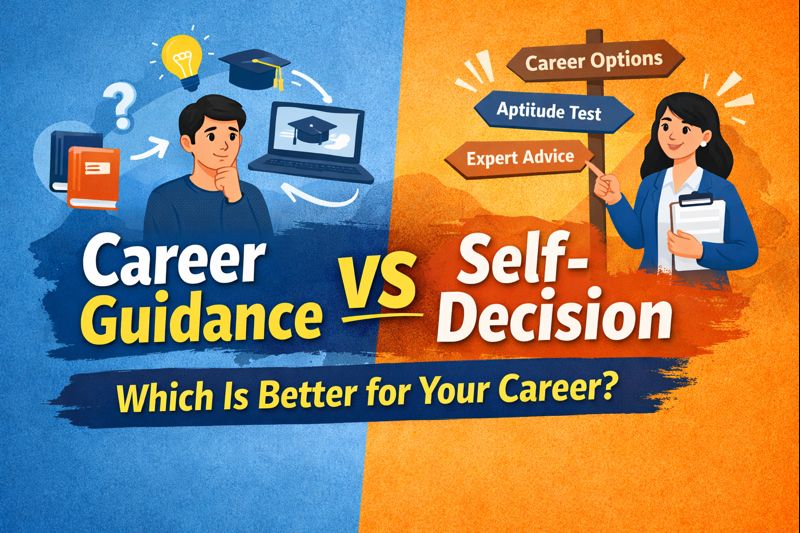
With unlimited information on the internet and increasing pressure from society, this confusion is completely normal. Let’s break it down and understand what really works better — self-decision or career guidance.
What Is Self-Decision in Career Choice?
Self-decision means choosing a career based on:
- Personal interests
- Academic performance
- Peer influence
- Family expectations
- Online research and social media
✅ Pros of Self-Decision
- Encourages independence
- Builds confidence and ownership
- Helps students explore their interests
❌ Limitations of Self-Decision
- Decisions may be based on incomplete or misleading information
- Students often choose careers based on trends, marks, or peer pressure
- Lack of clarity about aptitude, skills, and real-world job demands
- Emotional bias can lead to wrong choices
👉 Many students later realise: “I like this subject, but I don’t enjoy the career.”
What Is Career Guidance?
Career guidance is a scientific and structured process that helps students understand:
- Their aptitude
- Their interests
- Their personality
- Their strengths and weaknesses
- Suitable career clusters and pathways
It is usually supported by:
- Psychometric assessments
- One-on-one counselling sessions
- Expert insights into courses, colleges, and careers
Benefits of Career Guidance
1. Data-Driven Decisions
Career guidance uses assessments and analytics, not assumptions.
This reduces guesswork and confusion.
2. Clarity Beyond Marks
Good marks don’t always mean the right career.
Guidance helps students choose careers aligned with natural abilities, not just scores.
3. Exposure to New Career Options
Most students know only 10–15 common careers.
Career guidance introduces emerging, niche, and future-ready careers.
4. Saves Time, Money & Effort
Wrong career choices often lead to:
- Course changes
- Dropouts
- Loss of years and confidence
Career guidance minimizes these risks.
5. Balanced Decision-Making
It helps bridge the gap between:
- Student’s interest
- Parent’s expectations
- Market realities
Career Guidance vs Self-Decision: A Quick Comparison
| Aspect | Self-Decision | Career Guidance |
|---|---|---|
| Basis of choice | Assumptions & emotions | Scientific assessment |
| Awareness of options | Limited | Wide & updated |
| Risk of wrong choice | High | Low |
| Confidence level | Short-term | Long-term clarity |
| Career planning | Random | Structured roadmap |
So, What Works Better?
👉 The best approach is a combination of both.
- Self-awareness + professional guidance = Smart career decision
- Career guidance does not take away freedom — it empowers self-decision with clarity
Think of career guidance as a GPS:
- You still drive the car
- But the GPS helps you avoid wrong turns
Final Thoughts
In today’s fast-changing world, choosing a career without guidance is like navigating a new city without a map.
Career guidance doesn’t decide for students — it helps them decide better.
If you want a career that matches your potential, passion, and future opportunities, informed guidance can make all the difference.
✨ Confused about your career path? A structured career assessment can help you discover your best-fit career options.
–Salwa Naz
About us
“Unlock your dream career with Draw My Career! Our AI-powered platform, personalized report, combined with expert counseling and lifelong support, helps you discover your passion, stay focused on your goals, and achieve success. We proudly claim to have positively impacted over 3,000 students in and around Mangalore, receiving overwhelmingly positive feedback. For expert career guidance,Take the first step towards a brighter future and let us guide you to write your own success story.”
Visit: www.drawmycareer.com